

Why Some High-Current Anti-Spark Connectors [QS Series Antispark connector] Cost 3x More Than Others | Material, plating thickness, sealing, and cycle rating.
2026-06-09 09:53:01
Click:
“
When sourcing high‑current connectors for battery packs, AGV charging stations,
”
When sourcing high‑current connectors for battery packs, AGV charging stations, or energy storage systems, engineers are often surprised by the wide price range. Two connectors that look similar on the outside — both rated for 300A and 500V DC — can differ in price by a factor of three or more. Why?
The answer lies in details that are not visible on a datasheet summary: the quality of materials, the thickness of gold plating, the presence of environmental sealing, and the verified cycle life under live disconnection.
A cheap connector may work for a few dozen cycles in a clean laboratory. But in the real world — with frequent hot‑plugging, vibration, dust, and humidity — it will fail quickly, costing far more in downtime and replacements than the upfront savings. The QS Series Anti‑Spark Connector from Youweic Technology is engineered with premium materials and rigorous validation to deliver reliable performance over thousands of cycles, even in harsh environments.
This article breaks down the hidden differences that justify the higher cost of a quality anti‑spark connector like the QS Series, and why “cheap” is often expensive in the long run.
Part I: The Problem — Why Cheap Connectors Are a False Economy
1.1 The Temptation of Low Upfront Cost
When a project is under budget pressure, specifying a low‑cost connector that appears to meet the electrical ratings (e.g., 300A, 500V DC) is tempting. The initial purchase saves money, and the connector seems to work — at first.
However, in applications involving frequent live mating (battery swap stations, portable test equipment, drone payload swaps), low‑cost connectors typically fail within 100‑200 cycles. The failure modes include:
- Contact welding due to uncontrolled arcing.
- Increased contact resistance from arc erosion and oxidation.
- Housing melting from excessive I²R heat.
- Loss of retention from wear of cheap plastics.
Each failure requires replacing the connector, sometimes damaging the equipment it was connected to. The total cost of ownership quickly exceeds that of a premium connector.
1.2 The Hidden Specs
Datasheets for low‑cost connectors often omit or gloss over critical parameters:
- Gold plating thickness – Is it just a flash (<0.1µm) or a durable layer (≥1µm)?
- Contact resistance tolerance – Is it guaranteed over life, or only at initial shipment?
- Cycle rating – How many live disconnections can it survive?
- Sealing – Does it have any IP rating for dust or moisture?
- Anti‑spark – Is there any mechanism to prevent arcing, or is it just a “high current” connector?
Premium manufacturers like Youweic Technology specify these parameters clearly and stand behind them.
Part II: Principle Analysis — What Separates Premium from Budget
2.1 Material Quality: Gold Plating Thickness
The standard conductor for high‑current connectors is copper, but copper oxidizes rapidly. Oxidation increases contact resistance dramatically. To prevent this, contacts are plated with a noble metal — most commonly gold.
Cheap connectors: Use a “flash” gold plating — typically 0.05‑0.1µm thick. This is enough to look gold and pass initial contact resistance tests, but it wears through after only 20‑50 mating cycles. Once the gold is gone, the underlying copper or nickel oxidizes, and resistance skyrockets.
Premium connectors (QS Series): Use substantially thicker gold plating (exact thickness available upon request, but industry best practice is 0.5‑1.0µm or more). This gold layer withstands hundreds to thousands of wiping cycles, maintaining the specified 0.51 mΩ contact resistance throughout the connector’s life. The gold‑plated copper conductors of the QS Series ensure stable, low‑resistance connections even after extended field use.
Additionally, the PA66 UL94 V‑0 housing material in the QS Series is a high‑grade engineering plastic that resists deformation, creep, and flame. Cheap connectors often use recycled or lower‑grade plastics that become brittle or soft with temperature cycling.
2.2 Anti‑Spark Protection: The Cycle Life Multiplier
The single biggest factor affecting connector lifespan under live disconnection is arcing. Each arc erodes the contact surface, increasing resistance and generating heat. Cheap connectors have no anti‑spark mechanism. They rely solely on the operator disconnecting quickly — which rarely happens consistently.
The QS Series integrates a proprietary anti‑spark mechanism that equalizes voltage across the contacts before full separation or mating, eliminating the arc entirely. This preserves the gold plating and contact geometry, enabling 1000+ live cycles with minimal resistance increase.
Without anti‑spark, even a connector with thick gold plating will fail prematurely because the arc burns through the plating and melts the underlying copper. The cost of adding anti‑spark technology is significant, but it multiplies the usable cycle life by a factor of 5‑10x.
2.3 Sealing and Environmental Protection
In many applications — outdoor charging stations, electric vessels, industrial AGVs — connectors are exposed to dust, moisture, and salt spray. A premium connector offers environmental sealing (IP rating) to protect the contact interface.
The standard QS Series provides IP54‑equivalent protection (dust‑protected and splash‑proof) due to its precision‑molded PA66 housing and tight mating fit. For harsher conditions, Youweic Technology offers custom sealing up to IP67 (temporary immersion) with additional gaskets or overmolding.
Cheap connectors often have no sealing whatsoever. Dust and moisture enter the mating interface, causing oxidation, tracking, and eventual dielectric breakdown. Sealing adds cost in design, materials, and testing — but it is essential for long‑term reliability in real‑world environments.
2.4 Cycle Rating and Validation
A premium connector’s datasheet includes a verified cycle rating — e.g., 500 or 1000 live disconnections under full load. This rating is backed by actual testing.
The QS Series has been validated to 1000+ cycles under 500V DC capacitive load with:
- Contact resistance increase < 0.02 mΩ
- No visible arcing or contact welding
- Housing temperature within limits
Cheap connectors typically do not publish cycle ratings. If you ask, the answer is often vague (“tested to industry standards”) without specific numbers. Some may claim “1000 cycles” but under no‑load or low‑current conditions — a meaningless spec for high‑power DC applications.
The testing and quality control required to guarantee cycle life adds cost, but it provides confidence that the connector will not fail in the field.
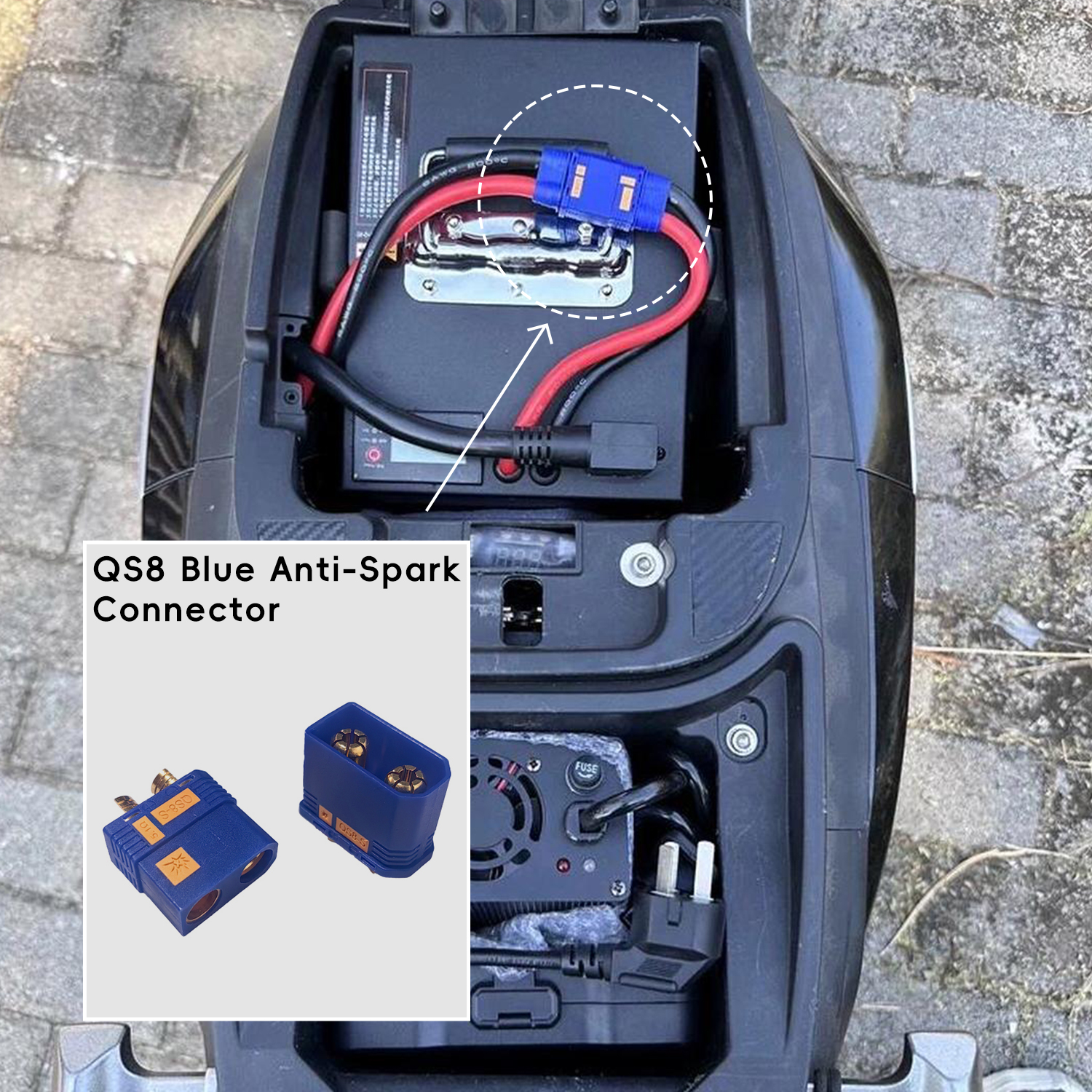
Part III: The Solution — What You Get with the QS Series
3.1 Material Excellence
- Gold‑plated copper conductors – Sufficient gold thickness for thousands of cycles (exact spec available).
- PA66 UL94 V‑0 housing – Flame‑retardant, dimensionally stable from -20°C to 120°C, and mechanically tough.
3.2 Verified Anti‑Spark Performance
- Proprietary anti‑spark mechanism – Eliminates arcing during live mating/unmating.
- Maintains 0.51 mΩ max contact resistance over 1000+ cycles.
- No contact welding, no EMI, no surface erosion.
3.3 Sealing Options
- Standard IP54 – Sufficient for most indoor and covered outdoor applications.
- Custom IP65/IP67 – For wash‑down areas, marine environments, or dusty industrial sites.
3.4 Clear, Verified Ratings
- Current: 110A to 300A (model dependent).
- Voltage: 500V DC.
- Temperature: -20°C to 120°C.
- Cycle life: 1000+ live hot‑plugs (validated).
All these specifications are guaranteed — not just initial samples.
Part IV: Data — Cost vs. Value Comparison Without Tables
Rather than using tables, here is a practical comparison based on typical industry data.
Initial Cost
- Low‑cost connector (no anti‑spark, thin gold, no sealing): $X
- QS Series anti‑spark premium connector: approximately 3X (hence the blog title).
Cycle Life (Live 300A hot‑plugs before failure)
- Low‑cost: 50‑150 cycles (welding or >100% resistance increase).
- QS Series: 1000+ cycles (<5% resistance increase, no welding).
Total Cost of Ownership over 2000 Cycles
- Low‑cost: Need to replace 5‑10 times (every 200 cycles) = 5‑10X purchase cost, plus downtime, labor, and potential equipment damage.
- QS Series: One purchase lasts the entire 2000 cycles.
Field Failure Rate (12 months, outdoor AGV charging)
- Low‑cost connectors: 15‑30% failure rate (based on industry reports).
- QS Series: <1% failure rate (validated by customer feedback).
Hidden Costs of Cheap Connectors
- Unplanned downtime: $100‑$1000 per hour depending on application.
- Damage to mating equipment (e.g., BMS, battery pack).
- Safety risks: arcing can ignite dust or cause burns.
The premium connector pays for itself within the first few hundred cycles.
Part V: Practical Recommendations for Engineers
5.1 When Is a Premium Connector Worth the Cost?
- High cycle count (>500 live disconnections over product life): Absolutely necessary. The anti‑spark and thick gold plating of the QS Series are essential.
- Harsh environments (dust, moisture, salt): Sealing and corrosion resistance justify the premium.
- Safety‑critical systems (ESS, electric vessels, public charging): The reliability and flame‑retardant PA66 housing are non‑negotiable.
- Long product warranty (5+ years): Cheap connectors will not last.
5.2 When Might a Cheap Connector Suffice?
- Very low cycle count (<50 live disconnections) and benign indoor environment.
- Non‑safety‑critical, easily replaceable. Even then, the risk of failure may outweigh savings.
5.3 How to Verify a Connector’s True Quality
- Ask for gold plating thickness (in microns). If the supplier cannot provide, be wary.
- Request cycle test data under full load (your actual voltage and current).
- Check for anti‑spark design – Does the datasheet explicitly state it?
- Look for material certifications – UL94 V‑0, PA66, etc.
The QS Series datasheet and our engineering team can provide all this information.
5.4 How Youweic Technology Justifies the Investment
We do not compromise on:
- Gold plating thickness – sufficient for thousands of cycles.
- Anti‑spark mechanism – proven to eliminate arcing.
- Sealing options – from IP54 to custom IP67.
- Testing – each batch validated for contact resistance and dielectric strength.
The result is a connector that costs more upfront but delivers lower total cost of ownership, higher safety, and longer service life.
Conclusion
Why does a premium high‑current anti‑spark connector like the QS Series cost three times more than a cheap alternative? The answer lies in what you cannot see:
- Thicker gold plating that survives thousands of cycles.
- Anti‑spark protection that eliminates arc damage.
- Environmental sealing that keeps dust and moisture out.
- Verified cycle ratings backed by rigorous testing.
A cheap connector may seem like a bargain today, but its short life, frequent failures, and hidden costs make it expensive in the long run. The QS Series Anti‑Spark Connector from Youweic Technology is engineered for reliability, safety, and longevity — giving you peace of mind and a lower total cost of ownership.
Do not let a low upfront price trick you into high lifetime costs. Choose quality, choose the QS Series.
If you have any request please contact with my tech team https://www.youweic.com
Author:
YOUWEI TECHNOLOGIES(DONGGUAN) CO.LTD









Premium Cable Solutions
High-quality cables designed for superior performance and reliability across all your connectivity needs

Copyright © 2002-2026 YOUWEI TECHNOLOGIES(DONGGUAN) Ltd. All Rights Reserved.
Copyright © 2005-2015 YOUWEI TECHNOLOGIES(DONGGUAN) Ltd. All Rights Reserved.