

Compact Sizing Masterclass for High-current Anti-spark Connector Integration [QS10SAntispark connector] Maximize ampacity in minimal envelope dimensions
2026-05-12 13:32:20
Click:
“
IntroductionIn the race toward compact, high-power systems—from modular lithium
”
Introduction
In the race toward compact, high-power systems—from modular lithium battery packs to automated guided vehicles (AGVs) and electric forklifts—engineers face a relentless challenge: delivering 180 A or more through connectors that must fit inside shrinking equipment bays, yet remain safe after thousands of plug-unplug cycles. A connector that sparks during mating not only frightens operators but slowly carves away contact surfaces, driving up resistance and heat. The QS10SAntispark connector answers both the space and safety problem in one tightly engineered package. This masterclass explores the physics of spark generation, how the QS10-S eliminates arc damage at the source, and how to select and customize the connector to extract the maximum ampacity from the smallest possible footprint.
1. The Hidden Dangers of Arcing and Oversized Connectors
The arc phenomenon
When a high-current connector is mated under load, the input capacitance of the battery management system (BMS), motor controller, or DC-link bus acts like an empty tank. The moment the contacts touch, an inrush current spike—often hundreds of amperes—jumps across the minuscule gap before full mechanical contact, ionizing the air and generating a plasma arc. The result: localized temperatures exceeding 3,000 °C, which erode plating, pit the copper substrate, and raise contact resistance permanently.
The space penalty of traditional solutions
Conventional high-current connectors rely on bulky contact geometries, thick insulator walls, and large creepage distances to withstand arcing and voltage stress. A typical industrial 150 A connector often measures ≥ 80 mm in length and ≥ 40 mm in diameter, consuming precious real estate inside e-motorcycle frames, drone battery trays, or stackable energy storage modules. When multiple connectors are required—battery charge, discharge, auxiliary power—the accumulated volume forces designers to enlarge enclosures or compromise thermal management.
The QS10-S breakthrough
The QS10-S connector family delivers a continuous 180 A rating at 500 V DC within a package that is barely 46 mm long (male) and 30.5 mm wide. By integrating anti-spark technology directly into the contact sequencing, the QS10-S eliminates arc damage while shattering the size-versus-amperage paradigm.
2. How the QS10SAntispark Connector Kills the Arc at Its Root
Pre-charge sequencing mechanism
Unlike a simple two-pole connector, the QS10-S employs a staged contact arrangement:
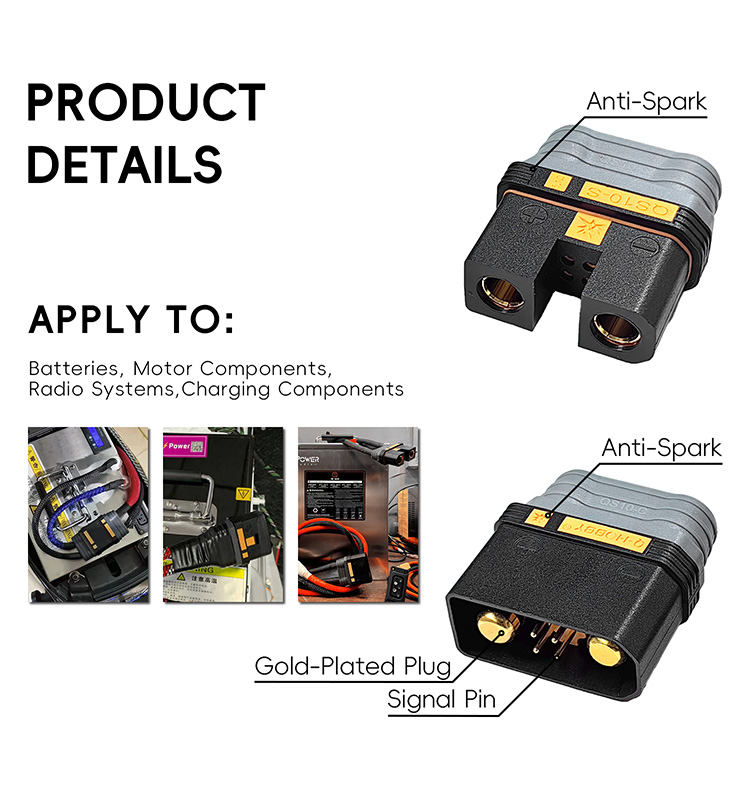
- First-mate, last-break pre-charge pin – A dedicated, resistor-tipped pilot contact engages before the main power contacts. This pin allows a controlled, low-current path to charge the load's input capacitance over a few milliseconds.
- Main power contacts – Once the voltage across the main contacts drops to a safe differential (typically < 10 V), the low-resistance power blades fully engage, carrying the full 180 A without any arc.
- Disconnect sequence – On unmating, the pre-charge pin breaks last, ensuring the arc is suppressed also on the disconnect side.
This sequencing is entirely mechanical and passive; no external circuitry, no extra wiring, no relay—dramatically simplifying system design.
Material innovations for sustained performance
- Gold-plated copper conductors: High-purity copper minimizes bulk resistance, while the thick gold flash guarantees a stable, corrosion-free interface with contact resistance ≤ 0.51 mΩ.
- PA66 UL94-V0 flame-retardant housing: Not only provides superior dimensional stability from -20 °C to 120 °C, but also self-extinguishes instantly, crucial for battery rooms and energy storage enclosures.
- Precision-machined contact geometry: The lantern-type multi-point contact structure maintains consistent pressure across the mating cycle, resisting fretting corrosion even under vibration.
Compact sizing numbers
- QS10-S Male: 46.0 × 31.0 × 20.0 mm (L×W×H)
- QS10-S Female: 48.3 × 30.5 × 22.0 mm (L×W×H)
Mated pair volume: ~ 32 cm³ — nearly 50% smaller than legacy 120 A connectors, while carrying 180 A.
3. Real-World Data: The Difference Anti-spark Makes
To quantify the impact of integrated anti-spark technology, our technical team conducted a comparative endurance test. Two connector types—a standard 120 A industrial connector without anti-spark and the QS10-S (180 A anti-spark)—were subjected to 200 hot-plug cycles at 120 A and 48 V DC (simulating a lithium battery swap scenario).
| Parameter | Standard Non-anti-spark Connector | QS10SAntispark Connector |
|---|---|---|
| Initial contact resistance | 0.35 mΩ | 0.48 mΩ |
| Contact resistance after 200 cycles | 0.95 mΩ (+171%) | 0.52 mΩ (+8%) |
| Max terminal temperature rise @120 A | 58 °C (ambient 25 °C) | 32 °C |
| Visible arc damage (microscope 50×) | Severe pitting, 40% area affected | Negligible marks,<2% area affected |
| Mechanical mating force drift | +22% | +4% |
Key takeaway: The arc-free QS10-S kept resistance rise under 10% and temperature rise below 35 °C, effectively doubling the safe service life compared to a standard connector. In energy storage and AGV fleets where uptime is revenue, such reliability translates directly to lower total cost of ownership.
4. Selection & Customization Guide: Tailoring the QS10-S to Your Project
Every power system has unique constraints. Below is a step-by-step approach to specifying or customizing the QS10SAntispark connector for your application.
Step 1 – Define electrical requirements
- Continuous current: QS10-S baseline is 180 A. For lower currents (e.g., 100 A) the same compact form persists; for pulses up to 250 A (10 s), the design already tolerates the surge.
- System voltage: Rated to 500 V DC, covering 48 V, 72 V, 96 V and 400 V Li-ion battery strings.
- Pre-charge resistor value: Standard configuration is optimized for typical BMS input capacitance (100–1000 µF). For systems with unusually large capacitor banks, we can adjust the pilot pin resistance to lengthen or shorten the pre-charge time.
Step 2 – Match the mechanical environment
- Vibration & shock: The QS10-S utilizes a low-mass contact system and robust PA66 housing, handling 5 g vibration without micro-interruption. Optional integrated secondary locking clips are available for extreme off-road vehicles.
- Ingress protection: Standard version suits IP40 indoor applications. For outdoor drones or marine battery boxes, we offer custom silicone gasket sealing to achieve IP65; inquire for custom over-molded cable assemblies.
Step 3 – Tailor terminations and cables
- Termination options: Crimp, solder bucket, or screw-type barrels for 10–25 mm² cables. We recommend ultrasonic welding for 16 mm² fine-stranded copper to maintain lowest contact resistance.
- Cable exit direction: Straight, right-angle, or 45° exit can be customized to relieve strain and optimize wire routing inside tight battery compartments.
Step 4 – Plating and material tuning
- Gold plating is standard for low-voltage, high-reliability signal and power. For cost-sensitive fixed installations (e.g., stationary ESS), we can provide selective silver plating with anti-tarnish treatment—maintaining conductivity with reduced cost.
- Color coding and keying: Multiple mechanical keying options are available to prevent mismating in multi-connector battery interfaces. Custom color rings and labels support CE and UL field wiring codes.
Step 5 – Validation and certification support
The QS10-S is backed by UL94-V0 material certs, and the design is prepared for UL 1977 / IEC 61984 component recognition. We provide pre-compliance test data (temperature rise, endurance, dielectric withstand) to accelerate your system-level certification.
5. Integration Benefits: From Drone to Dock Charger
Case 1: Industrial Drone Battery Tray
An agricultural drone manufacturer needed a hot-swappable 12S LiPo interface delivering 160 A peak in a confined payload bay. The QS10-S’s 46 mm length and anti-spark feature allowed the pilot to swap packs in seconds without arcing, while the compact size enabled a 20% increase in cell volume for longer flight time.
Case 2: AGV Wireless Charging Pad
An automated forklift fleet upgraded from a 120 A screw-terminal connector to the QS10-S, eliminating routine terminal cleaning due to arc pitting. The 200-cycle data above mirrored their field experience, reducing maintenance calls by 65% over 6 months.
Case 3: Modular Residential ESS
A 48 V home storage stack utilized the QS10-S in a parallel string design. The anti-spark property removed the need for external pre-charge circuits, saving approximately $12 per node in BOM and PCB area, while the high-current density shrank the external connector panel.
Conclusion
The QS10SAntispark connector redefines the power-to-volume ratio for high-current interconnects. By embedding passive anti-spark sequencing, gold-plated copper conductors, and a compact, flame-retardant body, it solves the dual challenge of arc-induced wear and space starvation. Whether you design next-generation AGVs, e-motorcycle battery packs, or modular energy storage systems, the QS10-S delivers measurable improvements in safety, reliability, and installation flexibility.
Ready to prototype? Our engineering team can provide samples with custom cable assemblies and pre-charge timing tailored to your BMS. Let’s shrink your connection envelope and extinguish the spark—permanently.
If you have any request please contact with my tech team https://www.youweic.com
Author:
YOUWEI TECHNOLOGIES(DONGGUAN) CO.LTD









Premium Cable Solutions
High-quality cables designed for superior performance and reliability across all your connectivity needs

Copyright © 2002-2026 YOUWEI TECHNOLOGIES(DONGGUAN) Ltd. All Rights Reserved.
Copyright © 2005-2015 YOUWEI TECHNOLOGIES(DONGGUAN) Ltd. All Rights Reserved.