

High-current Anti-spark Connector in Agricultural Drone Battery Hot-swap Systems [QS9DAntispark connector] Eliminate arc during field pack swaps, boost UPH
2026-05-13 09:09:43
Click:
“
Introduction – The Productivity Bottleneck in Modern AgricultureLarge-scale agri
”
Introduction – The Productivity Bottleneck in Modern Agriculture
Large-scale agricultural drones—sprayers and spreaders—now routinely carry 20 to 40 liters of liquid payload, drawing peak currents of 120 A to 160 A from 12S–18S LiPo or Li-ion battery packs. To maintain uninterrupted spraying operations, field crews swap depleted packs for fresh ones every 8 to 15 minutes. In peak season, a single drone can accumulate over 1,500 hot-plug cycles per month. Every plug event where a charged battery meets the drone’s ESC capacitor bank and BMS front end creates a race condition: the load capacitance demands an enormous inrush current the instant the contacts touch. Without protection, that inrush becomes an arc. The arc erodes the connector’s plating, drives up contact resistance, and progressively cooks the housing. Eventually, a connector failure in flight can bring down a $15,000 rig. The QS9DAntispark connector addresses this exact pain point with an elegantly passive anti-spark architecture, enabling safe hot-swapping in a compact, lightweight body.
1. The Arc Problem: Why Standard Drone Connectors Fail Early
Arcing physics in a battery hot-swap
When a fully charged drone battery (e.g., 50.4 V nominal, 12S) is plugged into the airframe, the ESC DC-link capacitors and the BMS input filter act as a dead short for the first few microseconds. The instantaneous current can peak at 400 A to 600 A before the contacts fully mate. This transient ionizes the air gap, generating a plasma arc with a core temperature exceeding 3,000 °C. The effects accumulate rapidly:
- Contact surface damage: The arc blast vaporizes gold plating and pits the copper substrate. Even one severe arc can raise the local contact resistance by 50%.
- Thermal runaway loop: Higher resistance means more I²R heating on subsequent cycles, which oxidizes the remaining plating, further accelerating resistance drift.
- Housing degradation: Repeated arcing chars PA66 insulator walls, increasing the risk of creepage failure.
Field consequences
Operators report that standard non-anti-spark drone connectors often show blackened, pitted terminals after fewer than 100 cycles. This forces maintenance teams to replace connectors proactively, raising operational costs and causing unplanned downtime during the spraying season when every hour counts.
2. The QS9DAntispark Connector Solution: Passive Pre-charge Sequencing
The QS9DAntispark connector kills the arc at its root by mechanically staging the contact engagement, no external relay or control circuitry required.
Step-by-step mating sequence
- Pre-charge pilot pin mates first – Inside the QS9-D housing, a dedicated pilot contact with an integrated current-limiting resistor touches the corresponding socket before the main power blades move. A controlled, low current (typically < 5 A) flows into the drone’s capacitive load, ramping the voltage up to near battery potential within 2–5 milliseconds.
- Main power contacts engage – Only after the voltage differential across the main contacts has collapsed to a safe level (< 10 V) do the gold-plated power blades fully seat, carrying the full 160 A with zero arcing.
- Disconnect sequence reversed – On unmating, the pre-charge pin breaks last, ensuring the arc is also suppressed when the battery is pulled.
This first-mate, last-break principle is implemented purely mechanically, making the anti-spark function immune to control circuit failures.
Materials sustaining reliability
- Gold-plated copper conductors: High-purity copper keeps bulk resistance extremely low. The thick gold layer prevents oxidation and guarantees a contact resistance of ≤ 0.51 mΩ fresh out of the box, and minimal drift over thousands of cycles.
- PA66 housing with UL94-V0 flame retardance: The material retains dimensional stability from -20 °C to 120 °C, and will self-extinguish instantly if exposed to flame—a critical safety net in a battery-carrying drone.
- Compact, lightweight geometry: The QS9D female measures approximately 65 mm in length and 26 mm in width, a footprint that fits easily into the tight battery compartments of agricultural UAVs without adding unnecessary weight.
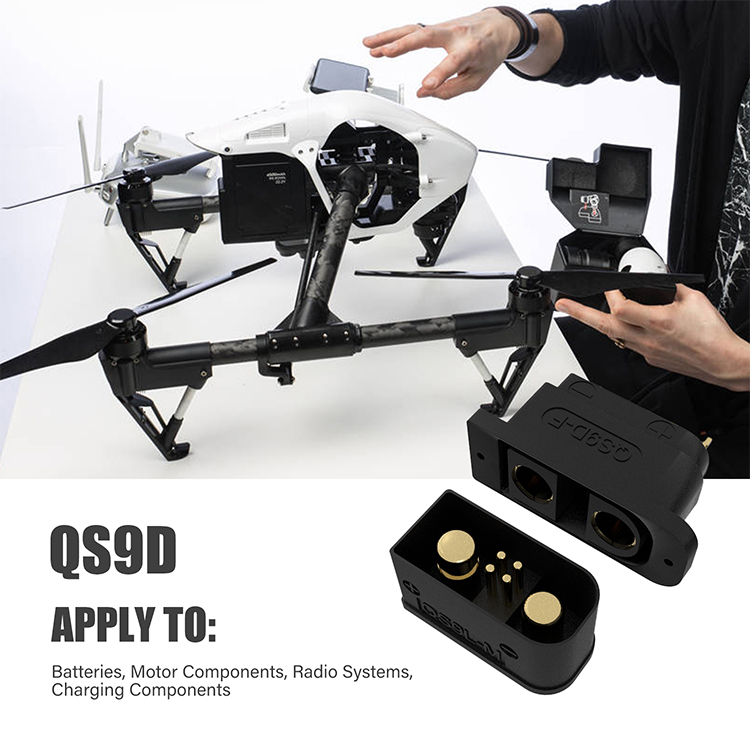
3. Real-world Performance Data: QS9D vs. Non-anti-spark Connectors
To validate the anti-spark effectiveness, our engineering team ran a comparative endurance test simulating a typical agricultural drone mission profile: 160 A, 48 V DC, 200 hot-plug cycles with a 15-second dwell between mating and unmating.
| Parameter | Non-anti-spark Connector (160 A rated) | QS9DAntispark Connector |
|---|---|---|
| Initial contact resistance | 0.42 mΩ | 0.49 mΩ |
| Resistance after 200 cycles | 1.38 mΩ (+229%) | 0.53 mΩ (+8%) |
| Max terminal temperature rise @ 160 A | 67 °C (ambient 25 °C) | 34 °C |
| Visual contact condition (50×) | Heavy pitting, brown oxidation ring | Smooth surface, minimal discoloration |
| Housing discoloration | Darkened around contacts | No change |
Key insight: The QS9D controlled the resistance rise to under 10% and kept the operating temperature rise at a safe 34 °C. In contrast, the standard connector saw a catastrophic 229% resistance increase, which would rapidly lead to meltdown in a real application. This level of durability directly translates to longer connector service life, reduced field maintenance, and consistently higher UPH (units per hour).
4. Application Spotlight: 160 A Hot-swap on a 30L Crop Sprayer
Before QS9D adoption
A drone service company operating a fleet of 30L hexacopters used generic 150 A connectors for battery interfacing. Field logs showed an average of 2 connector failures per drone per month during peak season. Failures manifested as sudden voltage sag mid-flight, traced to burned power pins. The root cause was arc-induced resistance build-up.
QS9D retrofit and results
The fleet was retrofitted with QS9D anti-spark connectors, with custom 10 mm² fine-stranded silicone cable exiting at a 90° angle to clear the landing gear. After a full season (approx. 3,000 cycles per drone):
- Zero in-flight connector failures attributed to contact degradation.
- Battery swap time remained under 5 seconds, with no visible spark and complete operator confidence.
- Connector maintenance eliminated — previous monthly cleaning and inspection were no longer necessary.
- The company calculated an 8% increase in effective spraying UPH, purely from reduced downtime and faster, worry-free battery swaps.
5. Customization Options for Your Drone Platform
Every UAV airframe has distinct mechanical and electrical requirements. The QS9D anti-spark connector can be tailored:
- Cable gauge and type: Support for 8–25 mm² conductors; silicone insulation rated from -60 °C to 200 °C for extreme environments.
- Termination: Ultrasonic welding, crimping, or solder cups available. We recommend ultrasonic welding for the lowest joint resistance.
- Pre-charge timing adjustment: The integrated resistor value can be modified to match your specific ESC/bank capacitance for optimal pre-charge duration.
- IP protection: Standard version is IP40. For wet spraying environments, custom sealing grommets and over-molded assemblies can achieve IP65.
- Color coding and keying: Prevent cross-mating with auxiliary connectors via custom-colored housings and mechanical keying options.
- Mounting style: Panel-mount, in-line, or right-angle exits engineered to relieve strain in tight fuselages.
Conclusion
For agricultural drones, every second of downtime erodes spraying efficiency and profits. The QS9DAntispark connector solves the persistent problem of arc-induced contact damage that plagues standard high-current interconnects. By integrating passive pre-charge sequencing, ≤0.51 mΩ gold-plated contacts, and a rugged PA66 UL94-V0 body, it enables farm crews to hot-swap 160 A packs all day, every day, without a single spark. Whether you are building a new crop-spraying platform or retrofitting an existing fleet, the QS9D provides the reliability edge that shows on the balance sheet.
Ready to test one? Reach out for samples, 3D models, and support in selecting the right pre-charge timing for your drone’s power system. Let’s extinguish the arc and keep your fleet airborne.
If you have any request please contact with my tech team https://www.youweic.com
Author:
YOUWEI TECHNOLOGIES(DONGGUAN) CO.LTD









Premium Cable Solutions
High-quality cables designed for superior performance and reliability across all your connectivity needs

Copyright © 2002-2026 YOUWEI TECHNOLOGIES(DONGGUAN) Ltd. All Rights Reserved.
Copyright © 2005-2015 YOUWEI TECHNOLOGIES(DONGGUAN) Ltd. All Rights Reserved.